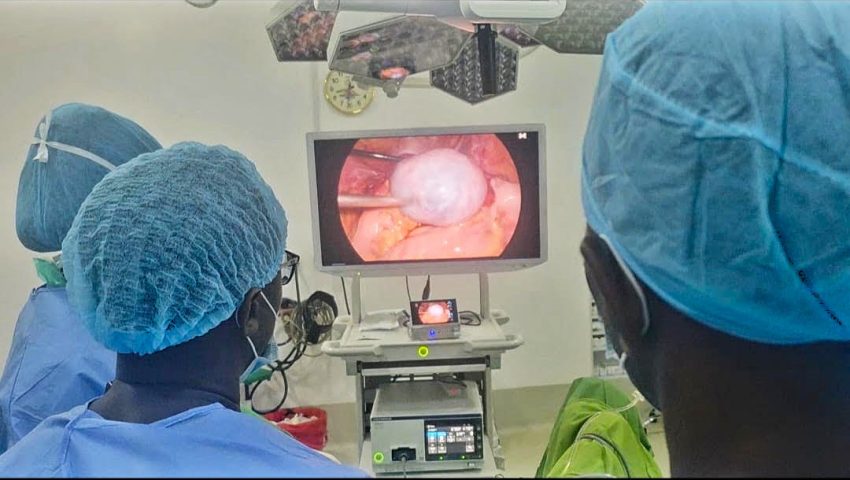
Photo courtesy of Dr. V. O. Tetty.
I came to at about 11 a.m., hearing what sounded like distant, muffled voices. Someone standing by the stretcher asked if I could hear him. I just stared, dazed. I felt extremely uncomfortable lying on my back and wanted to ask if I could lie on my side. I knew what I wanted to say, but my mouth could not form the words. The first attempt failed. I tried again. Instinctively, he leant in closer to hear what I was trying to say.
“Could I lie on my side? I’m uncomfortable,” I managed to whisper.
“Your side, yes, but not your stomach,” he cautioned.
I was relieved.
I was soon wheeled back to the ward and asked to roll over to my bed whose height had been adjusted to match the stretcher’s.
“Thaaaaaat’s going to hurt,” someone prepared me as I rolled over. I did not feel much pain though.
Having settled, I asked for my phone which had been taken for safekeeping at the nurse’s station. My family and few friends who knew about this needed to know that I made it out alive after all. My mother would later tell me that she could not do a single thing since morning until when she saw my message on our family WhatsApp group. She was not even able to eat. Earlier, she had asked if she could travel down to Mombasa to be with me, but since the doctor had said it wasn’t going to be a serious thing, I told her that we did not need to make a mountain out of a molehill, so she didn’t need to come. The surgeon had in fact intimated that he could discharge me that same day if I wanted to.
Most recently, while revisiting that day’s events after a review visit to the gynecologist, I felt quite a pang of melancholy as I reread the brief conversation in our family WhatsApp group. I had typed the first message at 11:47 a.m.: Procedure done. Four minutes later, my mother responded: Thanks be to God. At that same time, my ever rational brother asked: What’s the prognosis? I must have fallen asleep because it was not until 1:08 p.m that I replied: Sijaambiwa. Recovering from anesthesia.
I find myself profoundly unequipped to communicate potentially shocking or distressful news, especially events that draw attention to me as the one who is hurting or likely to unsettle others. For this reason, I did not call anyone at home to tell them that I was going to have a surgery. Instead, I typed it on the family WhatsApp group that we have just named ‘Home’: I have been scheduled for a laparoscopic surgery on 3rd June at Facility X. In hindsight, I find that to have been overly insensitive and inconsiderate because for one, I did not provide any background. There had been no illness that would at least justify this new development. Second, laparoscopic is such a big word-one which I did not even know about myself- leave alone the surgery part. Nevertheless, my ever rational big brother simply replied saying that I should inform them of the outcome. I later learnt that my worried mother had called this big brother for information breakdown and the level of risk. My big brother, who hardly ever panics, simplified it as ‘just something small.’ He did not even have the details himself, but isn’t it a blessing to have such a brother who can help to dissolve tension?
***
I received the first visit at around 3 p.m., and boy was I emotional. I had not realized how much I needed human presence until my good friend, Tosh, arrived. Mark you, he only learnt about my hospitalization from the WhatsApp story I had posted earlier. I had played all this invincible, strong, independent woman rejecting any idea or thought of seeking support. In fact, avoiding telling people was quite intentional. I felt that speaking about it, then repeating, then trying to justify it, would only gaive it more power and that would be deeply unnerving. To share, I thought, was to invite questions whose answers I did not have.
When Tosh saw the update, he called:
Chelaa, what’s up? Weren’t together yesterday? he asked, puzzled, referencing Sunday when I attended mass, upbeat as usual. What happened? Where are you?
I provided terse information because I could not sustain a long phone conversation. I realized that my voice was croaky, my throat extremely dry. I was not to take anything orally, not even the free God-given water, until I was permitted to. These were firm instructions from the nurse.
Tosh arrived in no time. Even though I felt weak, we chatted heartily and I was immensely thankful for laughter. It was the therapy I so badly needed. He is the sort who cracks jokes effortlessly, and catches any directed at him instantly. I am thankful for such spaces and friendships especially after finding myself more than once in spaces where I have either had to unpack a joke, layer by layer, to get people to laugh, or apologize for cracking a joke in the first place. Humour, I have learnt, is such a sophisticated sense that surprisingly eludes far more people than one might expect.
Tosh kept me company until Betty, who after a very demanding working day, had gone to buy me the essentials I needed, hospital kinda things, arrived. She came in at 5:00 p.m. carrying a bag stuffed with things, and for a moment I wondered what I was going to do without her, with my mother 700 kilometers away. It was Betty that supported me to the restroom. I was extremely dizzy and my tummy felt so uncomfortably big. Betty held me until I could sit on the toilet seat. Ladies and gentlemen, this had never happened to me. Every time I thought about that whole act of love later, my eyes welled up with tears. And in such an age of cosmetic friendships, having people who can sit by your side in very raw, vulnerable and unfiltered moments where you cannot go to such a personal space like the washroom by yourself, is priceless.
Betty is the one that I had given the details of my surgery. I had sensed that she was going to receive this news with calm having gone through a near-similar experience in the past herself. Besides, she is compassionate. Betty is compassionate. It is therefore quite easy to get vulnerable with her. I jokingly say that if God sends me a partner, he should come with Betty’s kind of compassion.
Betty stayed with me until the night fell. Until she could no longer stay.
***
I did not know about Dr. Bill prior to the first consultation neither had I ever heard about him. Well, in the main, I had never had a major concern that warranted a visit to one. So when he mentioned a surgery on this very first consultation I was taken aback, a little skeptical. How do I see you today and the next time we will be meeting in a theatre? What happened to the taking stage? I wondered. When I got home that evening, I began digging up information about him. Google and AI weren’t all that helpful, but there was an academic paper by his name on Research Gate. I skimmed through it and thought ‘well, fair enough,’ but anecdotal reference still mattered- like an actual human being testifying about him. I asked a friend and former colleague whom I had known to have been seeing a gynecologist at some point if she knew him. She did not. I became worried. I resorted to social media. Sadly, I could not locate his account on x, but found one on Facebook. The challenge however was that his account was such that you could access very limited content if you were not friends- in the Facebook sense- so I sent him a friend request. Never mind that he accepted it way after the surgery had been done.
Dr. Bill, as I have come to know him now, is one man with an intimidating look and a tough exterior, which begins to soften when he smiles. He said very little when I first went to see him, strictly clinical. His face remained bent over the computer the whole time as he typed my long list of symptoms. He only lifted his head to see me when he was explaining the possible causes of the endometrial thickening after the scans. He is soft-spoken though but this seems to be context dependent. On the morning of my surgery, before that door creaked and flung open, I heard him speaking authoritatively in something that sounded like a remote class in session. He dresses smartly, often, except when in the not-so- flattering doctors’ outfit. What’s more, he is remarkably knowledgeable about female reproductive issues, with facts readily at his fingertips. This was particularly striking for a doctor his age as we associate such deep expertise in this field with grey hairs. It was in fact the depth of his knowledge that disarmed me eventually and inspired the confidence to continue the course with him.
***
The night passed quietly and peacefully. The nurses were quite gentle, prompt and caring.
The following morning, I began to worry about when I was going to be discharged. Consequently, trust gave way to anger. I became angry at the state of helplessness in which I was. I became angry at the small bed, the white walls, the IV drips, the time that had seemingly stopped. Then I had this persistent stitch around my diaphragm whose cause could not be explained by the nurse on duty. How could I be in hospital and no one knew why I was in pain? I got angry at the surgeon, too. Why had he earlier said he could discharge me that same day yet he was still nowhere to be seen? Why did he appear very serious the previous day and said nothing beyond a solemn hello? In my desperation, I asked the nurse when I was going to be discharged. Her question about what discussion I had with ‘my doctor’ incensed me even more. Discussion? I wondered. My doctor? What if he had forgotten that I was there?
Then it all came back to me.
I remembered how I reminded Dr. Bill about the surgery. It was on a Sunday afternoon at around 3:00P.M. I had actually hoped to hear from him, but when after Mass there was still no message, I decided to text, then apologized for texting on a Sunday – a negative politeness strategy in Discourse Analysis. For context, the surgery was at first supposed to take place on Saturday, 1st June. But being a public holiday, the theatre would be understaffed and so we could not proceed. We agreed to move it to Monday 3rd June, which explains why I expected some form of communication on June 2nd. After dropping him the message, I went out shopping. While there, I received a message that I was to be admitted that evening in preparation for the surgery the following morning. I was baffled. Is this really it? My response to him was longer than necessary especially given his style of texting- one to two word answers- but it was still a reflection of my confoundment. I did not give away emotion, though. When you are aware of a power imbalance, you exercise restraint. Yet in hindsight, this very moment appears to have been the seed from which all my anger grew.
***
I spent the better part of the day teetering between half wakefulness and sleepiness. I could not use my phone much partly because of the stitch and partly due to the IV line. At around 1 p.m. there was movement. Two female nurses entered first and then the gentleman, the familiar face, Dr. Bill. They came in chatting. If my memory serves me right, he wore a blue shirt with a navy blue trouser. He looked neat and sharp. One of the nurses could not keep her eyes off him as he was asking me questions. She appeared spellbound or something. This nurse, I could tell, was embarrassed on my behalf when I effortlessly lifted my gown to show the surgery sites- one in the lower abdomen and another in the navel- to the surgeon. I mean, that was the only way in which the doctor could have accessed them. Besides, who really cares for shame in such a situation, especially with a surgeon before whom one’s whole naked body laid bare for examination only a few hours earlier? What I find so fascinating about male gynecologists is that they are probably the only men who do not sexualize the female body. To them, it is purely clinical, worth studying, even.
“How are you?” he asked gently.
I complained about the stitch and then the dizziness. He attributed the stitches to the theatre ‘angles’.
‘You are going to need to exercise,” he advised.
I felt relieved that there was someone at last with a logical and convincing explanation behind my discomfort- not that I know what theatre angles were. The dizziness, he attributed to high doses of morphine.
“How did you say you were feeling again?” he asked.
Here was Dr. Bill, I thought, finally confirming my fears- he had forgotten all about me. Yet, perhaps this was just part of the usual protocol.
I repeated my symptoms like a rehearsed poem as he listened keenly, maintaining eye contact, a powerful element in empathic communication.
“How many children do you have? he asked. This was not the first time he was asking this question.
“One,’ I answered with finality, one nurse looking at me, another one looking at him. That moment was heavy with tension.
“Do you want more children?” he went on.
“I … I do not know,” I responded in a tremulous voice, wondering where we were getting with it.
Was something terribly wrong? What did he find? Was I dying? Why is my wanting or not wanting more children important? These questions weighed me down.
The first time he had asked me about whether I needed more children, I had responded with an empathic NO. But this is one thing, I realized, that you can never be too sure about. Isn’t it said to leave room in the mind to revise opinion, after all?
“Well, you have to know what we found,” he said, his voice growing slightly louder and firmer especially at ‘you have to know’.
My child, I did not want to hear it, whatever it was. My heart was literary racing. I kept thinking about the four possible causes of hyperplasia, none of them anything to write home about. The visuals he had drawn on that first consultation while explaining the four possibilities lingered in my head stubbornly. I wished there was someone to squeeze my hand with assurance. The tension was nearly palpable.
“We looked at the uterus, we did not find anything physical. We went up (I do not know which part this up was exactly, but this is the up that had me being put down completely), we also did not find anything, so it’s likely that it’s purely hormonal.”
Pheeeewwww, I breathed. Why did they heighten my tension only to tell me about hormones? I felt a rush of anger once more.
“Your vitals will be checked and then you will be discharged,” he said finally.
Music to my ears at last! The Blood Pressure machine was brought in no time. My readings were quite low but I was to take fluids to stabilize.
A few minutes after he left, I remembered that we did not discuss my return to work formula, so I quickly found his number and texted. He swiftly replied that I would only go back after he’d assessed me at our kawaida facility, where it all begun.
‘’Tell the nurse at the discharge section to indicate that in your sheet,’ he wrote.
I did not know that discharge, especially when you are at the mercies of medical insurance, is a whole process on its own. If it was not for Betty to run up and down, I do not know how I was going to leave that hospital.
***
My recovery was quite linear and uneventful. Feeding took a few days to normalize. Even though I had this constant and nearly uncomfortable feeling of satiety throughout, my appetite normalized a few days later. And when it did, my hunger had doubled. I ate frequently. I loved mangoes. Succulent mangoes. The pain too subsided in a matter of days and I in fact defied the instructions to use painkillers for 10 days. I started to scale down by the fourth day. One particular one would have me feeling dizzy and confused instantly. That one I stopped very early on and stuck with Panadol advanced which I stopped too when I no longer found it necessary.
***
Laparoscopic surgery, also know as the keyhole surgery, is elegant in the sense that it is minimally invasive. As a result, the period of recovery is relatively short especially compared to open surgery, and the scars left behind are barely noticeable. Take, for example, my own mother who about 35 years ago underwent a pelvic surgery to remove an ectopic pregnancy. Her scar is large, deep and vertical almost splitting her lower abdomen into two equal parts. Then there’s me, 30 years later with a pelvic surgery scar that is barely noticeable. Technological advancement. Two women, two generations apart, and a striking difference.
During my recovery, I took time to read the medical report, comparing it with the ultrasound scans. Daktari’s handwriting is the legible type, not like the scribbles we are used to seeing on medical prescription sheets, but you can tell that he never used to write own lover letters back in the age of letter writing. He must have sought the services of a scribe because no girl would find that kind of handwriting attractive. Now in my comparison and little knowledge, compounded with a possible confirmation bias, I decided that there was an inconsistency between the two reports. This, I decided, I was going to demand an explanation for when I went for the review.
My first review was on a Friday afternoon, a day after I resumed work. I weighed 3kgs less on the scale. I was actually physically smaller. I showed up in a wig, and the expression on this doctor’s face, whether or not it was involuntary, was hilarious. This was my first ever wig. I realized I had lost the patience of sitting for long in the salon and I needed something on my head. This new, foreign look never escaped people’s notice but it worked for me in the sense that it diverted their attention, especially colleagues, from my prolonged my absence, causes, etc. While ordering for it, I had felt deeply remorseful for the fiercely opinionated comments I made against wigs when I was twenty-seven and high on Chimamanda Adichie’s work. I did not know then that a wig could one day be one of the many ways of solving female problems.
There are usually three seats inside the doctor’s room- particularly in Room 5 where Dr. Bill normally sits- and one bed for examination. One chair is the doctor’s. It’s with a table on which a desktop computer is placed. The remaining two seats are besides the table, adjacent to each other. When I entered the room, I sat on the second chair from the table, placing my back pack on the one closest to the table and the doctor.
“Hello, mbona umekaa mbali?” Dr. Bill asked.
I ignored the second part of the question and responded to the greeting.
“How are you?’
“Fair enough,’ I replied
“What’s fair enough,’ he asked laughing. That was the first time I saw him laughing, light-hearted.
I laughed, too.
“Umerudi job?’
I answered in the affirmative.
“How was your first day?”
“I was off,” I admitted, “but it’s starting to feel normal again.”
After examination, he went through my history quickly, re-explained what they found and explained how he avoided pricking my uterus in case I may want to carry a pregnancy in future. He also explained the risk of pricking, one being that it may not heal as desired and that may breed problems in future. All this he said calmly and in a layman’s language. I remember that he used the word, ‘kugwaragwara’.
“So what explains the inconsistency?” I managed to ask at last.
‘In ….” he asked, interested.
“The scans and the findings of the surgery.”
I had read and re-read the report. It had not indicated a thickening and that had me wondering whether we did a surgery when we didn’t need to.
He clarified that my endometrium was indeed think but that was the only thing. That there were no growths and there was therefore no need to obtain any tissues. That, my child, was disarming and for once that resentment began to crumble, block by block. I remembered that this doctor actually gave me options of hospitals that would not blow up my thin medical cover. Who does that in this age when illness is commercialized? That was an act of kindness, I thought. He did not have to. He’d have left me to go figure.
We agreed that I would do another scan immediately after my period. That was to be in two or three weeks thereabouts.
***
The first period after this surgery was extremely painful. I threw up. I had diarrhea. And for the first time my face appeared swollen for some hours. When it ended I went for a scan as advised. My endometrium was still abnormally thick.
‘It’s thickening again,” Dr. Bill remarked as he studied the scan.
“Ikiendelea hivi, we may want to do another procedure to obtain a tissue.’
Hearing the word procedure, I nearly jumped. I told him that I was still recovering from surgery trauma and could not hear of such a thing
“You didn’t even see anything,’’ he said softly.
I insisted, and he agreed to a two months break. One thing with Dr. Bill is that he listens, and he is very considerate.
Now, I have never known painless period for the twenty years that I have been menstruating. The only break I had was during the nine months’ period when I was pregnant with my son, and an additional six months that my periods took to return. I had harrowing experiences in secondary school and this time of the month became one of the most dreadful and one I resented the most. After my baby, the pain intensity varied and to date I cannot quite put a finger on what exactly affects how painful it gets. Or why I am extremely nauseous in some months and not in others. Or why in some months I have a loose stool and not in others. Or why I have breast soreness in some months and not in others. So despite all the undesirable events that were happening, I hang on to the silver lining that perhaps I was going to find a lasting solution to this problem that had clearly overstayed. One that has in fact caused me another chronic problem, gastritis.
On that second visit, I decided to ask if there was a permanent solution to period cramps. My hope was dimmed before it could fully flare. First, Daktari did not seem to appreciate my use of the word ‘permanent’ and in an effort to perhaps comfort me, he told me that he also occasionally takes painkillers for different reasons. I honestly felt that that comparison was unfair, and an attempt at minimizing my lived experienced as common place. I wished he saw it as an expression of a deep desire to be free from pain rather than a nagging complaint granted this was the first time in my life I was talking to a specialist in this area about this concern. In hindsight, I appreciate the raw honesty. There is no point in telling comforting lies, in selling hope where none exists. And this has had me thinking especially about the content by gynecologists I follow on the socials who have constantly asserted that period pain is not normal. I think there is a need for these professionals to exercise caution in how they use language and come clean on which kind of pain exactly is considered abnormal because what then do you tell a patient whom after all assessments, you find nothing physical to attribute that pain to. What do you tell them?
***
In the two months cooling period, and in my attempt to escape the possibility of another procedure, I resorted to Arorwet, a herbal formulation by Harriet’s botanicals, a product with overwhelming positive reviews especially in regards to curing infertility, painful menses associated with endometriosis, shrinking fibroids and clearing cysts. I took three bottles- each for twenty-two days- with a seven days break between each bottle. What they do not tell you about this concoction is that it is an aphrodisiac of sorts. Now you are in your thirties, dealing with wild ovulation spells, and then you add fuel. Whether by sheer coincidence, hope, or healing, something shifted. The next scan report read ‘unremarkable pelvic scan’. This was a first in a long time. After the third bottle, it was thinner by another 0.1 cm, placing me on a safe range at last. Little progress but worth celebrating.
I have seen two gynecologists in my life so far. The first one was in K.U hospital in my undergrad days. This one diagnosed me with an early pregnancy. I was only twenty. The second would be Dr. Bill, 13 years later, who found me with endometrial hyperplasia. I saw him last on January 9. Considering the positive progress, we agreed that all factors held constant, I will be seeing him again in January, 2027. May the stars align in my favour, and may God bless Dr. Bill and all the good doctors.
This article brings back such wonderful memories. You stayed strong the entire time and kept encouraging me. The way you’ve described the gynecologist even makes me wish I could meet him. Seeing you after the surgery really made me happy.
As for one of the nurses—wueh —at first I honestly didn’t like her and even questioned her competence.later I realized she was simply being professionally diligent. It’s just that when someone you love is unwell, you expect the medical team to act like magicians and handle every tiny detail perfectly.
Thanks for reading,love. I’d still recommend him when the time comes to see a gyna. I agree with you that vulnerability alters our judgement. I’ll admit I judged him a bit unfairly earlier, though I was still observant. It surprises me that nearly a year later, I can say all that about him.
Readings panned with the literature accenture, put out the struggles women go through silently. The final part of the story where Harriet Botanicals comes in shows how modern medicine and traditional medicine have been interconnected. Wishing you well
‘Nikuletee nini’
‘Maembe tamu’ as if I wa to taste all of them and know they were succulent 😂😂 . Such a nice read thanks Chelaa
Ha ha ha.
Thanks for reading, Tosh, and for your immense support during that period.❤️
Wow! I was engrossed all through good job?
Thank you for reading, Linnet. 🩷